
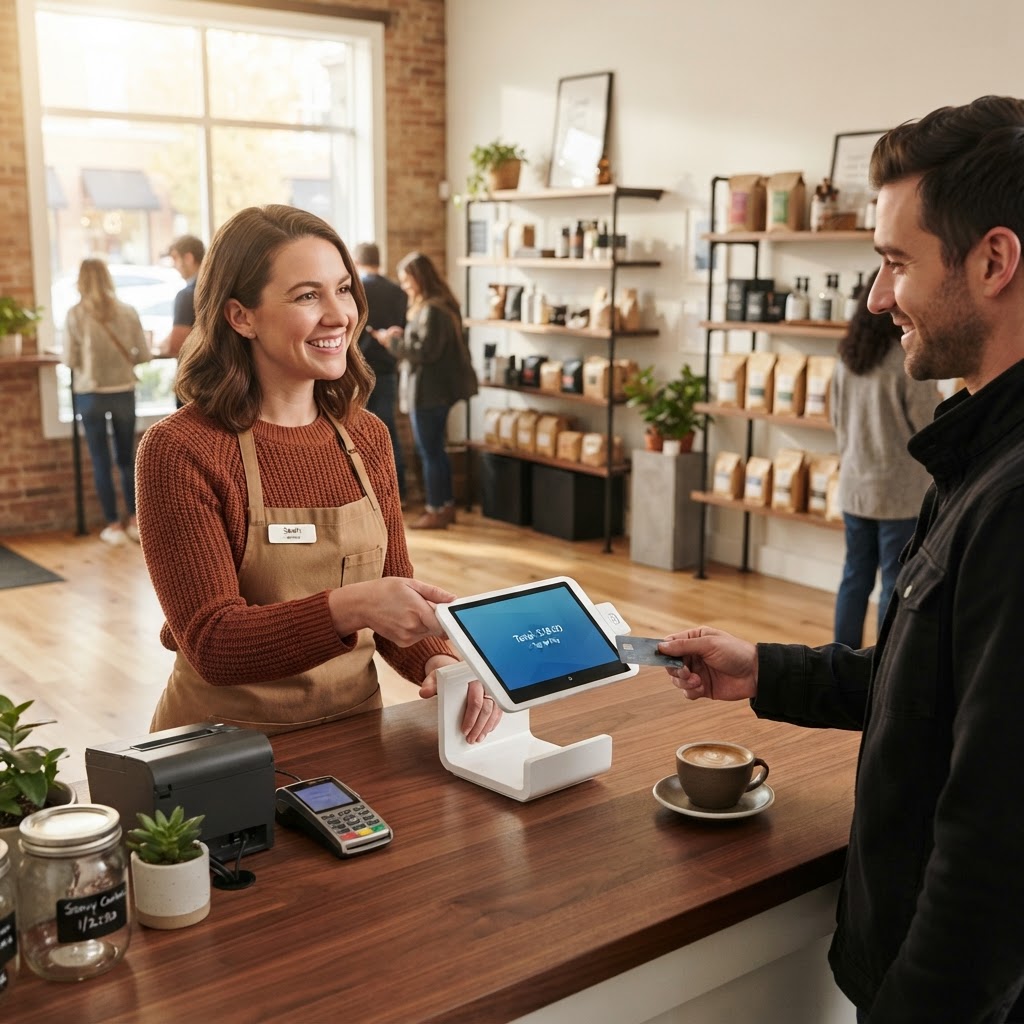
How to Select the Best Merchant Services for Small Business
Choosing the right merchant services for small business can lower your overhead by 40% while protecting your revenue from sudden account freezes.
Choosing the right merchant services for small business involves more than finding a low headline rate; it requires a provider that offers transparent interchange-plus pricing, stable account underwriting, and integrated hardware designed for your specific industry. For most U.S. small businesses, a dedicated merchant account is the optimal solution because it provides higher deposit limits, lower long-term transaction costs, and better protection against the unexpected fund holds common with generic payment aggregators. By focusing on providers that offer month-to-month agreements and clear fee structures, you can build a financial foundation that scales with your growth without the risk of predatory pricing or locked terminals.
Defining Merchant Services for Small Business
Merchant services for small business represent a specialized category of financial products that allow a company to accept and process electronic payments. This is not a single tool but an ecosystem comprising several key components: the merchant account (where funds are held before being transferred to your bank), the payment processor (the entity that moves the data), the payment gateway (the digital bridge for online or keyed-in sales), and the physical hardware. For companies operating in the U.S., the quality of these services directly impacts cash flow and customer trust.
Our experience shows that many owners mistake a payment aggregator for a dedicated merchant service. Aggregators group thousands of businesses into one massive account. While this allows for instant setup, it creates a high-risk environment where a single unusual transaction can cause the processor to freeze your entire balance for weeks. A dedicated merchant account, conversely, assigns a unique identification number to your business. This requires more effort during the application phase but provides the stability necessary for businesses processing more than $5,000 monthly. When we look at long-term viability, the dedicated model is nearly always the better investment for serious professional operations.
Merchant Account vs. Payment Aggregator: Choosing Stability
Determining whether to use an aggregator or a dedicated provider is your first strategic decision. Aggregators like Square or Stripe are ideal for micro-businesses, side hustles, or seasonal vendors. They use a flat-rate pricing model that is easy to understand but often more expensive as your volume grows. Because they perform minimal vetting at the start, they use aggressive risk-management algorithms that can halt your ability to take payments without warning if they suspect any deviation from your normal sales pattern.
For established or growing companies, merchant services for small business should almost always mean a dedicated account. These accounts undergo a process called underwriting before you start processing. The bank reviews your financial history, business model, and expected volume. While this takes a few days, it results in a relationship where the processor understands your risks. For service businesses, this is vital. If you land a large commercial contract and suddenly swipe a $20,000 deposit, a dedicated provider expects it, whereas an aggregator might flag it as fraud and hold the funds indefinitely.
Transparent Pricing: Decoding Interchange-Plus Structures
The way you are billed is the most critical factor in your total cost of ownership. Most providers offer one of three pricing models: flat-rate, tiered, or interchange-plus. Flat-rate charges a set percentage for every transaction regardless of the card type. Tiered pricing groups transactions into 'qualified,' 'mid-qualified,' and 'non-qualified' categories, often pushing the majority of your sales into the highest-cost bucket without your knowledge.
Interchange-plus is the most transparent model and the one we recommend for every client. In this structure, the processor passes the exact cost of the transaction—set by the card networks like Visa or Mastercard—directly to you, adding a small, fixed markup. This allows you to see exactly what you are paying the card issuers versus what you are paying your processor. According to the Federal Trade Commission, understanding these specific fee components is the only way to effectively compare providers. Using this model is the first step to reduce credit card processing fees because it eliminates the hidden margins found in tiered plans.
Avoiding Contractual Pitfalls and Hidden Fees
When evaluating merchant services for small business, the fine print in the contract often holds more significance than the advertised rate. Many traditional processors attempt to lock businesses into three-year contracts with liquidated damages clauses. These clauses require you to pay a massive penalty if you switch providers before the term ends. We advise sticking to providers that offer month-to-month service agreements. This forces the processor to earn your business every month through quality support and competitive rates.
Watch out for these common ancillary fees that can quickly erode your margins:
- PCI Non-Compliance Fees: If you do not complete your annual security questionnaire, some processors charge $30 to $100 per month as a penalty.
- Monthly Minimums: A charge applied if your total processing fees do not meet a specific threshold, typically $25 to $35.
- Batch Header Fees: A small charge, often $0.10 to $0.25, every time you 'close out' your terminal for the day.
- Statement Fees: A redundant charge for providing a monthly summary of your transactions, which should be free via a digital portal.
- Gateway Access Fees: If you sell online, you may be charged a monthly fee to use the payment gateway for small business in addition to your per-transaction costs.
Integrating Your Point of Sale Systems and Software
Modern payment processing is no longer just about the terminal on the counter. The hardware you choose must act as a data hub for your entire operation. A modern point of sale system should integrate with your CRM for service businesses to sync customer data and purchase history automatically. This integration reduces manual entry errors and provides a more comprehensive view of your customer lifecycle.
For retail and restaurant environments, hardware like Clover or Pax offers a balance of security and functionality. These systems handle inventory management, employee clock-ins, and loyalty programs. For field service businesses, such as plumbing or HVAC, mobile payment processing is essential. Using a handheld terminal that connects via Wi-Fi or cellular data allows your technicians to take payments on-site, improving cash flow and reducing the time spent chasing unpaid invoices. We often recommend 'unlocked' hardware, which is equipment not tied to a single processor. This prevents 'terminal locking,' ensuring you can take your hardware with you if you decide to change merchant service providers in the future.
Security Requirements and PCI DSS Compliance
Every business that accepts credit cards is required to maintain compliance with the Payment Card Industry Data Security Standard (PCI DSS). These rules are established by the PCI Security Standards Council to prevent data breaches and protect consumer information. While compliance might seem daunting, the right merchant services for small business will provide the tools to make it manageable.
Using modern hardware that supports end-to-end encryption (E2EE) and tokenization is the most effective way to secure your business. Tokenization replaces sensitive card data with a unique 'token' that has no value to hackers. This significantly reduces your 'PCI scope,' meaning you have fewer security hurdles to jump because the actual card data never enters your local network. We emphasize that compliance is an ongoing process, not a one-time checkmark. Regularly updating your systems and training staff on secure payment handling is a baseline requirement for any modern business.
Field Scenarios: Seeing Results in Action
Scenario 1: The Transition from Aggregator to Dedicated Account An electrical contracting firm in Georgia was using a popular flat-rate aggregator for all its field billing. As they grew to $1.2 million in annual revenue, they noticed their effective rate stayed stuck at 2.9% plus a per-transaction fee. More concerningly, a $15,000 payment for a commercial warehouse project was flagged, and the aggregator held the funds for 21 days for 'review.' This delay nearly prevented them from making their weekly payroll. By switching to a dedicated merchant account with interchange-plus pricing, their effective rate dropped to 2.1%. More importantly, because they had a dedicated account manager who understood their business model, their high-ticket transactions were processed and deposited the next business day without interference.
Scenario 2: Modernizing a Retail Point of Sale A small boutique retailer was using an outdated dial-up terminal and a manual spreadsheet for inventory. They were paying high 'tiered' rates because their old hardware couldn't support the latest security features. We helped them implement an integrated point of sale system that handled both their in-store sales and their new e-commerce website. By consolidating their merchant services for small business into one integrated system, they saved 12 hours of administrative work each week. The system automatically adjusted inventory levels across both channels and provided real-time sales data that helped them make better purchasing decisions.
Frequently Asked Questions
What is the average cost of merchant services for small business?
The average cost typically ranges from 2.0% to 3.5% of total sales volume. However, these figures are highly dependent on your industry and how you accept payments. Card-present transactions (swiping or dipping a card) are generally cheaper than card-not-present transactions (online or over the phone). Businesses using interchange-plus pricing often see much lower effective rates than those on flat-rate or tiered plans because they avoid hidden markups on low-risk cards.
How does a payment gateway for small business differ from a processor?
A payment processor is the company that handles the actual communication between the merchant, the card networks, and the banks. A payment gateway is the software 'doorway' that securely captures the data and sends it to the processor. If you are a brick-and-mortar store, the gateway is often built into your terminal. If you sell online or through digital invoices, the gateway acts as the interface that validates the transaction in real-time before sending it for processing.
Is mobile payment processing secure for field technicians?
Yes, mobile payment processing is highly secure when using modern encrypted card readers. These devices use the same security standards as countertop terminals, including EMV chip technology and point-to-point encryption. As long as the data is encrypted at the point of interaction and your technicians use a secure app provided by your merchant service provider, the risk of data theft is minimal compared to old-fashioned paper invoicing or manual card entry.
What documents are needed to open a dedicated merchant account?
To open a dedicated account, you generally need your business tax ID (EIN), articles of incorporation or a business license, a few months of business bank statements, and a physical address. The underwriter will also review your website to ensure you have clear return and privacy policies. This level of documentation is what provides the higher security and lower rates that dedicated merchant services for small business offer compared to instant-approval aggregators.
Can I use my existing hardware with a new merchant service provider?
It depends on whether your hardware is 'locked' or 'unlocked.' Many large processors provide proprietary equipment that only works on their specific network. However, many industry-standard devices like those from Pax or Clover can be 'reprogrammed' or 're-injected' to work with a new provider. Before signing a new agreement, always ask for a compatibility check on your existing equipment to avoid unnecessary hardware replacement costs.
Conclusion: Choosing Your Merchant Services for Small Business
Selecting the right merchant services for small business is a foundational step in your company's financial health. By moving away from expensive flat-rate aggregators and toward transparent, dedicated accounts, you gain the stability and cost savings needed to compete in today's market. Prioritize providers that offer interchange-plus pricing and integrated hardware that works with your existing software. This approach ensures that your payment systems support your growth rather than becoming a bottleneck of high fees and held funds.
At Procomm 360, we help businesses identify the most efficient ways to process payments while maintaining the highest security standards. Whether you need to update your point of sale systems or want a transparent review of your current processing statement, our team is ready to assist. Explore our payment processing options or check out our comprehensive service suite to see how we can streamline your operations. When you are ready for a partner that treats your business with dedicated attention, contact our team for a consultation. Securing the right merchant services for small business is the smartest way to protect your margins and ensure your cash flow remains steady as you scale.